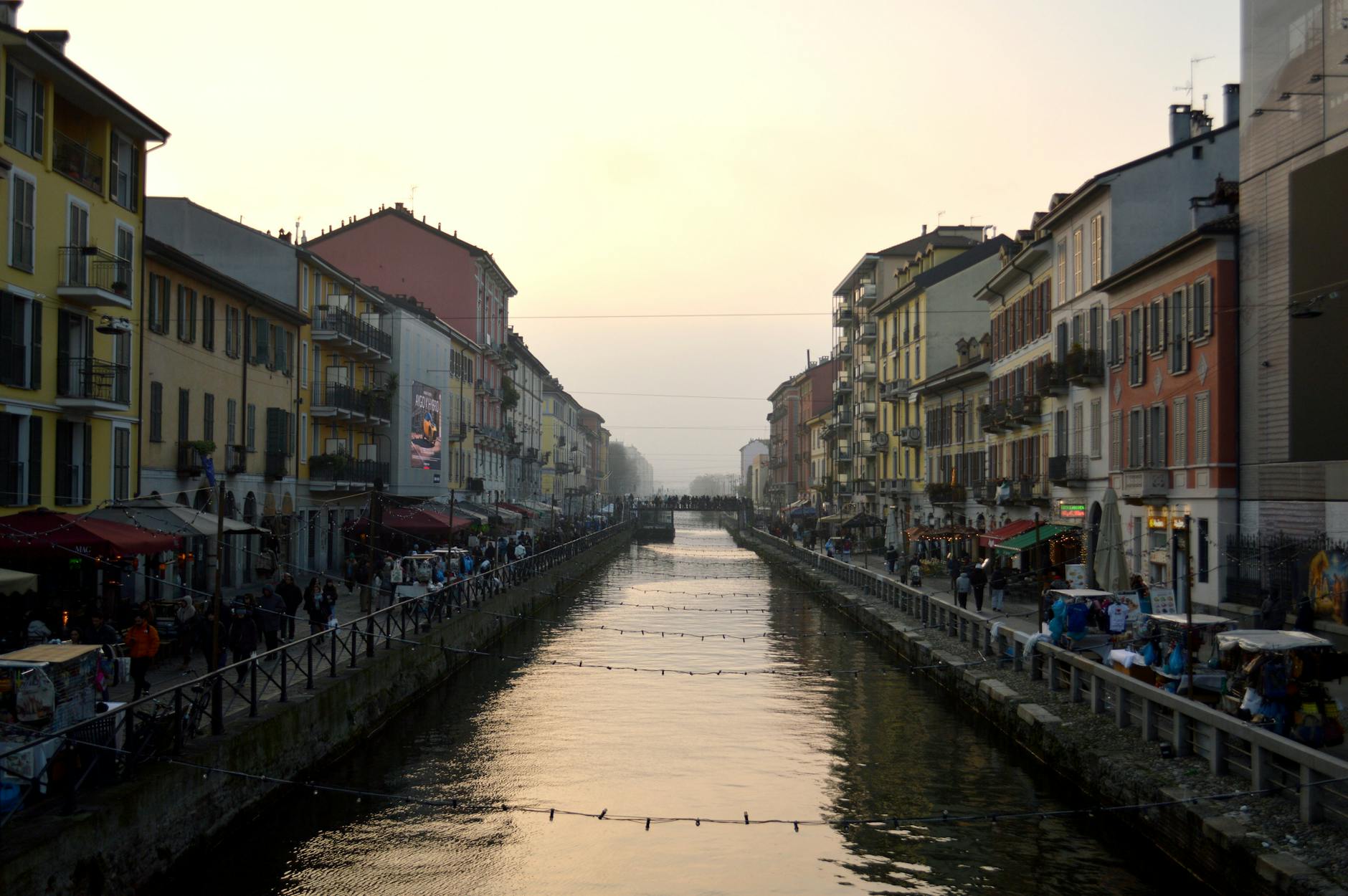
Milan’s Navigli district doesn’t look like the rest of the city. Where the centro storico is all marble and sharp angles, the canals feel softer — faded ochre buildings reflected in still water, washing lines strung between balconies, the smell of aperitivo drifting from every other doorway. It’s the part of Milan that locals actually hang out in after work, and it’s one of the best neighbourhoods in Italy to explore on foot.
The two main canals — Naviglio Grande and Naviglio Pavese — form the backbone of the district. Both are walkable, both have their own character, and both reward slow wandering over rushing through. Whether you join a guided tour or plot your own route, here’s what’s worth your time.
A Quick History (It Helps to Know This)
The Navigli canals weren’t built for atmosphere. They were a medieval engineering project, started in the 13th century when Galeazzo Visconti ordered a canal connecting Milan to Pavia and eventually to the sea via the River Po. Leonardo da Vinci later designed an improved lock system that made the canals navigable for larger vessels.
For centuries, these waterways were Milan’s economic lifeline. The marble used to build the Duomo was shipped along the Naviglio Grande. By the mid-20th century, the Darsena — the old port basin — was the 13th busiest port in Italy. The last cargo docked at Porta Ticinese in 1979, and after that the canals went quiet.
Then something shifted. The neighbourhood attracted artists, students, and eventually bars and restaurants. Today the Navigli is one of Milan’s most sought-after residential areas and its best nightlife district. But traces of the working-class past are everywhere if you know where to look.
Guided Walking Tours Worth Booking
If you want context and stories rather than just pretty canal views, a guided tour makes a real difference in the Navigli. Here are the best options:
Strawberry Tours Free Navigli Tour
This is a tip-based free walking tour that covers the greatest hits: Basilica di Sant’Eustorgio, the Arco di Porta Ticinese, the Darsena, and the Ponte Alda Merini. Runs about two hours. The guides are local, knowledgeable, and genuinely entertaining — this isn’t a robotic script. You’ll hear about how the Basilica supposedly housed relics of the Three Magi before they were transferred to Cologne. Good starting point if you’ve never been to the Navigli before. Book through strawberrytours.com.
GetYourGuide Private Navigli Walking Tour
A private tour with a local guide, typically lasting around two hours. The advantage here is flexibility — you can ask questions, linger at spots you find interesting, and skip what doesn’t grab you. Covers the canal history, the Leonardo da Vinci lock system, and dips into the side streets and courtyards that group tours tend to miss. Prices start around €50-70 for a private group, which splits nicely between two or more people.
WithLocals Off the Beaten Track Navigli Tour
This one deliberately avoids the most touristy stretches and takes you into the residential side of the Navigli. You’ll see hidden courtyards, street art, and spots that don’t appear in guidebooks. The local host aspect means you’re walking with someone who actually lives in the neighbourhood, not someone who commutes in to give tours. Typically runs 2-3 hours. Book through withlocals.com.
Musement Guided Tour with Aperitivo
A guided walk through the Navigli district that finishes with an aperitivo at a canal-side bar. This is the one to pick if you want the history but also want to end the evening properly. The aperitivo is included in the price and usually involves a Spritz or Negroni with snacks. Available through musement.com — runs in the late afternoon so you catch the golden hour light on the canals.
Walking the Navigli on Your Own
You don’t need a guide to enjoy the Navigli. The canals are straightforward to navigate and the best bits are all within a compact area. Here’s a self-guided route that covers the essentials in about 90 minutes (longer if you stop for coffee or aperitivo, which you should).
Start: Basilica di San Eustorgio
Begin at the basilica on Piazza Sant’Eustorgio. This is one of Milan’s oldest churches and it’s where new archbishops of the Diocese are traditionally received. The Cappella Portinari inside is considered one of the finest Renaissance works in the city — it was commissioned by a Florentine banker named Pigello Portinari who ran the Medici bank’s Milan branch. Worth stepping inside even if you’re not normally a church person.
Along Corso di Porta Ticinese to the Naviglio Grande
Walk along Corso di Porta Ticinese toward the canals. You’ll pass the Arco di Porta Ticinese, a neoclassical gate originally called Porta Marengo after Napoleon’s victory. The street is lined with independent shops, vintage stores, and cafes — it’s a good stretch for browsing.
Vicolo dei Lavandai
Turn off into this tiny alley right on the Naviglio Grande. The old stone washboards and wooden shelters are still here — this is where women from the neighbourhood came to wash clothes in the canal water. It’s a tiny spot, easy to miss, but it’s one of those frozen-in-time corners that makes the Navigli special. There’s often a small exhibition or art installation set up in the covered area.
The Darsena
The old port basin, built in 1603, was renovated for Expo 2015 and is now the beating heart of the district. On Saturday mornings, the Fiera di Sinigallia flea market sets up here. The rest of the week it’s cafes, people on bikes, and one of the best spots in Milan to sit with a coffee and watch the city go by. Every last Sunday of the month, a large antiques market takes over the canal-side streets — worth timing your visit around if you’re into that.
Naviglio Pavese
Cross over to the quieter canal. The Naviglio Pavese runs 33 kilometres from Milan to meet the Ticino River near Pavia, though you only need to walk a short stretch to get the feel of it. It’s more residential, with fewer bars and more street art. In spring, flowers bloom along the canal edges and it’s genuinely picturesque. The hidden courtyards along here — peek through open doorways — often reveal unexpected gardens and old workshops.
Spazio Alda Merini
At Via Magolfa 30, this small house-museum honours the poet Alda Merini, who spent most of her life in the Navigli and captured its spirit in her writing. Inside you’ll find a reconstruction of her bedroom with original furniture, photographs by Giuliano Grittini, and poetry panels. Open Tuesday to Sunday, 10am to 6pm. It’s intimate and genuinely moving — even if you don’t know her work, the atmosphere of the space communicates something.
End: Chiesa di San Cristoforo
If you want to extend the walk, continue along the Naviglio Grande to the Church of San Cristoforo. Its 15th-century bell tower was once considered the “lighthouse” of the city — the landmark that barges watched for as they approached Milan. This is the quieter end of the Navigli, away from the aperitivo crowds. Tram number 2 can take you back to the centre from here.
Street Art Along the Canals
The Navigli is one of Milan’s best areas for street art, and it’s the kind that’s integrated into the neighbourhood rather than feeling like a tourist attraction. The walls of canal-side buildings are covered in murals — some political, some purely decorative, some genuinely brilliant. The stretch along the Naviglio Pavese has the highest concentration. No map needed — just keep your eyes up and duck into side streets.
When to Visit
Late afternoon into evening is the best time. The canal-side bars come alive around 6pm for aperitivo, the light turns golden, and the whole district takes on a different energy. Morning visits are quieter and better for photography — the reflections in the canals are clearest before the foot traffic picks up.
Last Sunday of the month for the antiques market along the Naviglio Grande. It’s huge, it’s chaotic, and it’s brilliant for browsing even if you don’t buy anything.
Avoid Saturday nights in summer unless you enjoy crowds. The Navigli is Milan’s go-to evening-out district and the canal-side streets can get packed.
Spring and early autumn are the sweet spot. Warm enough for outdoor aperitivo, cool enough that walking for two hours doesn’t feel like a workout.
Getting There
Take the M2 metro line to Porta Genova. From there it’s a five-minute walk to the Naviglio Grande. Tram 3 from Piazza del Duomo drops you at the Basilica di San Eustorgio if you want to start from there. The whole Navigli area is compact — you won’t need any transport once you’re in the neighbourhood.